
Why code reviews matter more than ever in the AI era
- Walter Galvão
Founder

AI made writing code 10x faster. Copilots autocomplete your functions. Agents open PRs while you sleep. Vibe-coding turns a prompt into a prototype in an afternoon.
But all that code still needs to be reviewed. And that's where things are falling apart.
We optimized code generation but forgot about code validation. Review queues are drowning, reviewers are burned out, and more PRs are getting rubber-stamped than anyone wants to admit. Code reviews are more important now than they've ever been. And most teams need to rethink how they approach them.
The new bottleneck
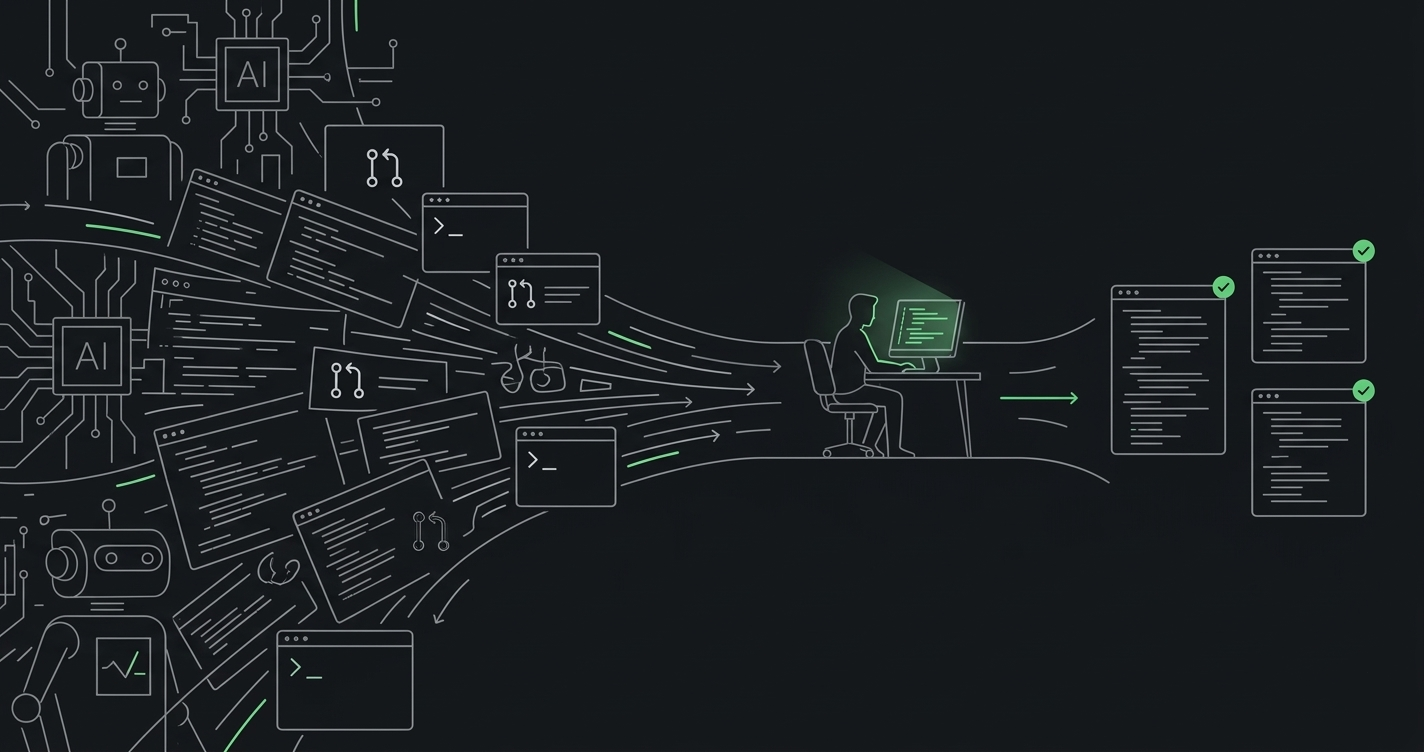
The bottleneck used to be writing code. Now it's reviewing it.
AI copilots and agents generate code faster than any human ever could. That means more pull requests. From humans who write faster with AI assistance. From agents that generate entire features autonomously. From junior developers who now produce code at a pace that used to take years of experience.
The PR queue is growing. Fast.
Reviewers are overwhelmed. They context-switch between their own work and a pile of PRs that never stops growing. They skim instead of reading. They approve instead of questioning. Not because they don't care, but because there aren't enough hours in the day.
And when "just approve it" becomes the default, things break.
Picture this: a PR lands on Friday afternoon. It's 800 lines. The reviewer glances at it, sees nothing obviously wrong, and hits approve. It ships. That night, payments break. The on-call engineer spends three hours debugging something they've never seen before, in code they've never touched. Nobody on the team can explain what the change was supposed to do, because nobody actually read it.
That's what happens when rubber stamps replace real reviews. More bugs in production. Longer incident recovery. Customer impact. Tech debt piling up silently under a growing pile of "approved" PRs. Everyone knows it's happening, but no one has time to fix it.
Code reviews matter more now than they ever did. Here's how to do them well.
How to author a reviewable PR
If you want good feedback on your PR, make it easy to give. The author's job starts long before someone clicks "review."
Use a PR template. Every PR should have a clear title, a description of what changed and why, testing notes, and screenshots if the change is visual. The reviewer shouldn't have to guess what your PR does. If they need to read the ticket, the diff, and three Slack threads just to understand the context, you've already lost them.
A good template doesn't need to be complicated. A title that follows a convention. A "what" section. A "why" section. A "how to test" section. That's it. But it makes a real difference.
Self-review before requesting review. Go through your own diff before tagging anyone. Read every line. Catch the typos, the leftover debug logs, the TODO comments you forgot to clean up. If you wouldn't approve your own PR, don't ask someone else to.
Your self-review should cover the same things a reviewer would check. Does it meet the requirements? Are edge cases handled? Are there tests? Everything in the next section applies to your self-review too.
Keep PRs small and focused. One concern per PR. If you can't describe what it does in one sentence, it's probably too big. Big PRs get rubber-stamped. Small PRs get real feedback. You choose. Google's own engineering research backs this up. Their In Praise of Small Pull Requests ↗ post shows that smaller changes get reviewed faster, with fewer rounds of feedback, and ship with higher confidence.
This is even more important in the AI era. AI tools make it easy to generate large changes quickly. That doesn't mean you should ship them as a single PR. Break them up. Your reviewers will thank you.
Use draft PRs for early feedback. If the change is risky or you're unsure about the direction, open a draft before you've written the full implementation. Get a thumbs up on the approach before sinking hours into it. This saves everyone time and avoids the painful "great code, wrong direction" feedback after you've already finished.
Add comments to your own PR. Walk the reviewer through confusing sections. Explain decisions that might raise questions. Call out trade-offs you considered. "I went with approach X instead of Y because..." saves a full round of back-and-forth and speeds up the entire review cycle.
The best PR authors treat their reviewers as collaborators, not gatekeepers. Make their job easy, and you'll get better feedback, faster.
Include tests. AI makes writing tests faster than ever. There's less excuse for PRs showing up without them. A PR with good test coverage is easier to review because the reviewer can trust the tests to catch regressions and focus their energy on design and logic instead.
How to be a good reviewer
Reviewing code is a skill. It's not just reading diffs and looking for bugs. It's about understanding what changed, why it changed, and whether it was the right call.
Check the requirements first. Go back to the ticket. Does the PR actually do what was asked? Are all acceptance criteria met? This is the first thing to verify before diving into code details. You'd be surprised how often a PR looks correct at the code level but doesn't actually solve the problem.
Review the "why", not just the "what." Does this approach make sense? Is there a simpler way to achieve the same result? Sometimes the code is clean and well-tested but the whole approach is off. That's the kind of feedback that matters most, and it's the kind only a human who understands the system can give.
Look at what's missing. Error handling, edge cases, tests, logging. The absence of something is harder to spot than a bug in the code, but often more dangerous. Ask yourself: what could go wrong that this PR doesn't account for?
Pay extra attention to AI-generated code. It often looks clean but misses context. It uses patterns the team doesn't follow. It has subtle logic issues hidden under well-formatted syntax. AI writes confident-looking code. That doesn't mean it's correct. Don't let polished-looking diffs lower your guard.
Ask questions instead of making commands. "What happens if this value is null?" lands better than "You forgot to handle null." Questions invite conversation. Commands invite defensiveness. The goal is to make the author think, not to make them feel bad.
Don't blame. Code reviews are about the code, not the person. "This function is hard to follow" works. "You wrote this wrong" doesn't. Small wording changes make a big difference in how feedback is received.
Don't nitpick code style. That's what linters and formatters are for. Configure them, enforce them in CI, and never argue about semicolons in a review again. If your team is debating tabs vs. spaces in PR comments, that's a tooling problem, not a review problem.
Explain the "why" behind your suggestions. "This could cause a race condition because two threads access this without a lock" teaches something. "Change this" doesn't. Every review comment is a chance to share knowledge. Take it.
Be timely. A review that sits for 3 days is a review that blocks delivery. If you can't get to it today, say so. Let the author find someone else or come back to it when you can. Speed matters.
Acknowledge good work. "Nice approach here" or "Good catch on that edge case" costs nothing and builds trust. Reviews shouldn't only be about what's wrong.
Know when to approve vs. request changes. Reserve "request changes" for things that will actually break: production incidents, security issues, data loss risks. For everything else, leave comments. Requesting changes feels heavy for the author. And if your branch rules already require approval before merging, your comments won't get ignored.
Sometimes something isn't perfect but needs to move. That's a judgment call. It's OK to approve with a note: "this works, let's address X in a follow-up."
Handle disagreements gracefully. Discuss in the PR comments first. If it's going in circles, hop on a quick call. If you still can't agree, let the author decide and document the trade-off in the PR. Don't let a PR sit for days over a disagreement. Shipping something good today beats shipping something perfect next week.
At the end of the day, a code review is a conversation. Not an inspection.
AI, automation, and the guardrails you need
AI generates more code, faster. That's great for velocity. But it also means more things can go wrong, and they go wrong faster too. You need layers of defense to catch problems before they reach a human reviewer.
The risks of AI-generated code
AI is confident. Always. It will generate code that looks perfectly clean, reads well, and passes a casual review without raising a single flag. But confidence isn't correctness.
Hallucinations are real. AI will call API endpoints that don't exist. It will import libraries that were never installed. It will use method signatures that look right but don't match the actual interface. It will reference database columns that aren't there. The code compiles, maybe even passes a few tests, but it's built on something that was made up. This is especially dangerous because it looks so plausible. Authors need to verify every external call, every import, every assumption the AI made. And reviewers need to be just as skeptical. If you see a method call you don't recognize, look it up. Don't trust that the AI got it right.
Happy path only. AI is great at writing code that works when everything goes right. But production isn't the happy path. What happens with empty inputs? What about concurrency? Retries? Partial failures? Timeouts? AI-generated code rarely handles these well, and they're exactly the kind of thing that causes incidents at 2am. Your tests should cover them. Your reviewers should ask about them.
Security is a big one. AI models are trained on massive amounts of public code, and a lot of that code is insecure. SQL injection patterns, hardcoded secrets, missing input validation, insecure defaults. AI doesn't think about threat models. It reproduces patterns it's seen, and many of those patterns are vulnerable. Both authors and reviewers should pay extra attention to security in AI-generated code. Don't rely on eyeballing it.
Automate what you can
The more guardrails you have in your CI pipeline, the less your human reviewers need to catch manually. And in an era where code volume is exploding, this matters more than ever.
Use a typed language with a build step. If your language has a type system, use it. A compile error will catch a hallucinated API call or a wrong method signature instantly. No reviewer needed. This is one of the cheapest and fastest guardrails you can have.
Run static analysis and security scanners. Tools like GitHub's CodeQL, Semgrep, or Snyk can catch security vulnerabilities automatically. SQL injection, cross-site scripting, insecure dependencies. These tools aren't perfect, but they catch the common stuff that humans miss under review fatigue. Run them in CI so every PR gets scanned before anyone reviews it.
Enforce linters and formatters. This was mentioned in the reviewer section, but it deserves repeating here. If style checks, import ordering, and formatting are automated, nobody wastes review time on them. Configure it once, enforce it in CI, and forget about it.
Run your test suite. If the tests pass, the reviewer starts with higher confidence. If they don't, the PR shouldn't even be up for review yet. Make this a hard gate.
The goal is simple: by the time a human opens the PR, the obvious stuff is already handled. Type errors caught. Security scan clean. Tests passing. Linting green. The reviewer can spend their time on what actually requires a human brain.
AI review tools
There's also a growing category of AI code review tools. CodeRabbit is probably the most well-known, but new ones keep showing up. These tools automatically review your PRs and leave comments about bugs, patterns, style issues, and security flags.
They're genuinely useful. They catch the repetitive stuff humans are bad at being consistent about. Missing null checks, unused imports, potential issues that a tired reviewer would miss at 4pm on a Friday. An AI reviewer doesn't get tired, doesn't have a bad day, and reviews every PR with the same level of attention.
But they have the same blind spots as the AI that wrote the code. They don't know your business logic. They don't know that your team decided last month to stop using that pattern. They don't know that "we tried this approach before and it broke in production." They can't tell you whether the overall design makes sense for this problem in this codebase.
AI reviews should be a first pass, not the final word.
Here's the workflow that works: automated checks run in CI (types, tests, linting, security scans). The AI review tool comments on the PR. The author addresses all of it before requesting a human review. By the time a person looks at it, the noise is cleared. The reviewer can focus on what actually requires human judgment: architecture, business logic, the overall approach, and whether the change makes sense in the bigger picture.
This layered approach saves everyone time. But it doesn't replace the person who actually understands what the code is supposed to do and why.
The manager's playbook for code reviews
Most articles about code reviews stop at the IC level. But if you're an engineering manager or tech lead, you have a different job. You're not just reviewing code yourself. You're building the system that makes good reviews happen consistently across your team.
Define the process
Who reviews what? There are several options. Round-robin assignment. Tag the team and whoever is available picks it up. Domain-based assignment where certain people own certain areas. Author picks the reviewer based on context.
There's no universally right answer. Every team is different. What matters is that the process is explicit. Don't let reviews happen by accident, where the same two people always end up reviewing everything because nobody else stepped up.
Pick something. Stick with it for a while. Give it enough time to actually produce results. Then measure the outcomes. Are reviews happening faster? Are fewer things slipping through? Is the load balanced across the team?
If it's not working, talk with the team. Propose a change. Iterate. Measure again. Keep doing this until you find what fits. Every team is different, and what works for one won't work for another. This takes experimentation, and that's fine. The worst thing you can do is not have a process at all.
Spread review ownership
Don't let the same 2-3 seniors be the bottleneck for every review. Spread the load intentionally.
Junior developers reviewing senior code is one of the best learning tools out there. Tell them to ask as many questions as they want. That's the whole point. But the benefit goes beyond individual growth. Knowledge spreads across the team. Bus factor goes down. You stop depending on the same few people for everything.
This builds system knowledge faster than any onboarding doc ever will.
Watch the metrics
You can't improve what you can't see. Pay attention to:
- Time to first review. How long do PRs sit before someone looks at them?
- Time from review to merge. Is there a lot of back-and-forth? Are PRs getting stuck after the first round of feedback?
- PR size. Average lines changed per PR. If PRs are consistently large, reviews will be consistently shallow. PR size is a leading indicator of review quality.
- Review balance. Who is doing most of the reviews? Is it evenly distributed? Look for overloaded reviewers, especially people who become a focal point for cross-team reviews. And look for people who aren't reviewing at all.
When reviews are consistently slow
If your team's reviews are always slow, diagnose the root cause before throwing solutions at it.
- Capacity problem? Too many PRs, not enough reviewers. Spread ownership, push for smaller PRs, and consider AI tools for the first pass.
- Priority problem? People treat reviews as lower priority than feature work. Set the expectation that reviews come first. Blocked PRs block delivery for the whole team.
- Focus problem? Reviewers context-switch too much and never find a good time to review. Try batching review time. A daily "review slot" where the team clears the queue can work well.
- Knowledge problem? Reviewers don't feel confident reviewing certain areas. Pair on reviews. Spread system knowledge intentionally.
Most slow review cultures have a mix of these. Start with the biggest one and work from there.
Teach the craft
Don't assume your team knows how to author good PRs or how to give helpful review feedback. Teach them. Show examples of great reviews from your own team. Share what good PR descriptions look like. Make it concrete.
Set the expectation that code reviews are a first-class engineering activity. Not a chore you rush through between other tasks.
Coach through reviews
This is one of the most underused coaching tools a manager has.
Before your 1:1s, or whenever you set aside time for it, go through the PRs your reports reviewed. It takes 15-20 minutes and tells you a lot.
Look for rubber stamps. Huge PRs approved with zero comments? That's a red flag worth discussing.
Look at tone. Are they being helpful or hostile? Are they asking questions or making demands?
Look at depth. Are they catching real issues, or just surface-level stuff?
This tells you more about someone's engineering maturity than any standup or sprint retro ever will. And it gives you something concrete to coach on.
Conclusion
AI made code cheaper to write. That makes reviews more valuable, not less.
Whether you're an IC improving how you author and review PRs, or a manager shaping the process and coaching the team, better reviews mean fewer incidents, less rework, and a codebase your team actually trusts.
The teams that get this right will be the ones who treat code reviews as a skill, a process, and a culture. Not just a gate to rush through.